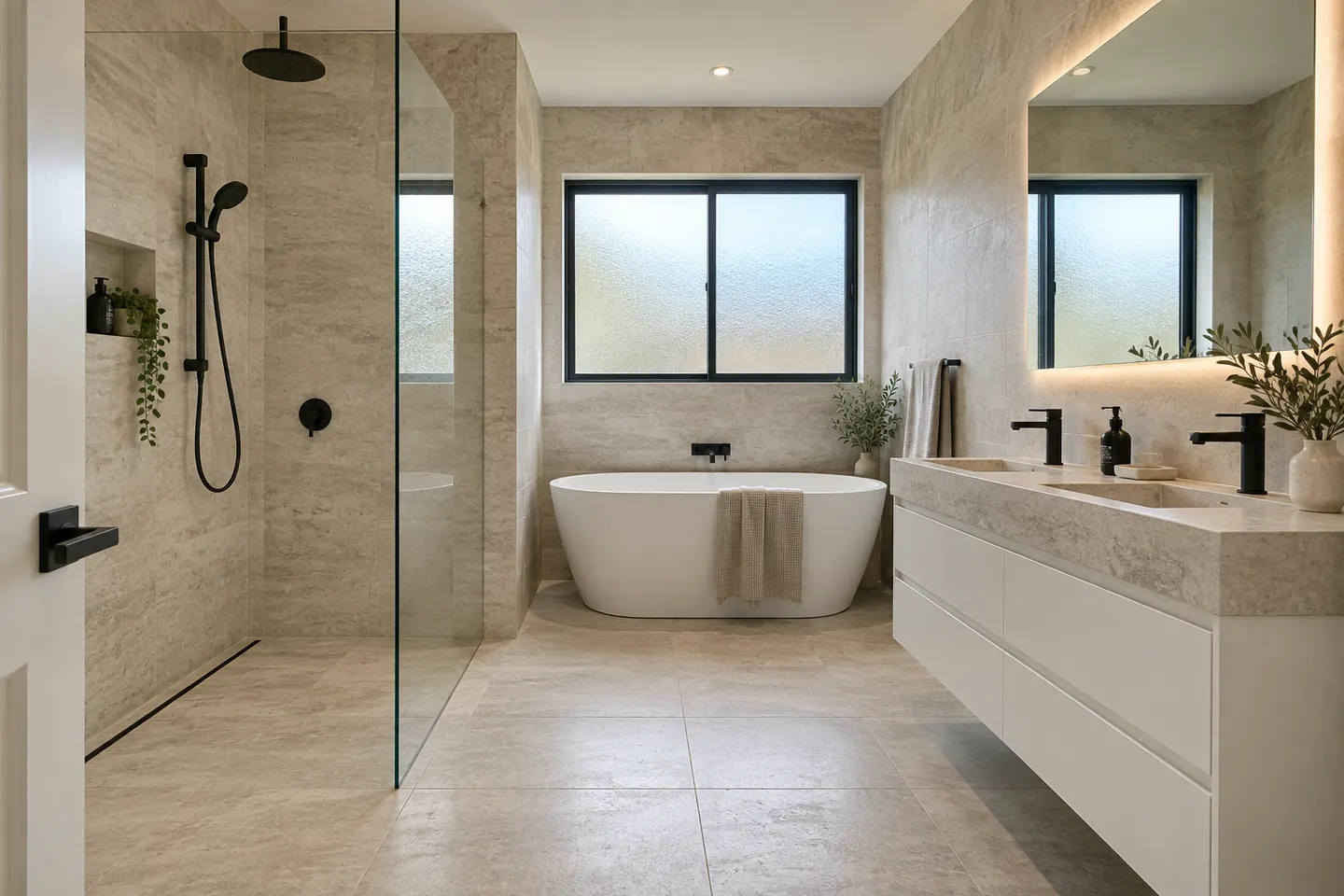
Why this is a different brief
An owner-occupier renovation is about how the room feels to live with for fifteen years. A rental bathroom is about risk and downtime. The specification that wins is the one that fails least often, cleans easily, and can be repaired with parts bought locally.
That is not the same as cheap. A bathroom built down to the lowest number tends to come back: a screen that leaks at the base, a vanity carcass that swells, tapware nobody stocks a cartridge for, a floor that is slippery when the tenant mops it.
Where this work comes from around here
The wide post-war blocks across Canterbury-Bankstown carry a lot of secondary dwellings and duplex development. Three kinds of job turn up most:
The investment house between tenancies. Original 1960s bathroom, decades of partial fixes, and a two or three week window with the property empty. The brief is a complete, durable room finished inside the vacancy.
One half of a duplex. Often newly built or recently completed, where the bathroom needs finishing or upgrading to match the other side. Slab floors, tighter layouts, no asbestos risk, and a set of decisions that can be repeated on the second half.
A granny flat or secondary dwelling. Small, usually a single wet room of about 1.5 by 2 metres, and frequently built for a family member rather than a tenant — which in this area is extremely common. Those get built closer to an owner-occupier standard, often with accessibility planned in from the start.
The specification that holds up
- Porcelain floor tiles with a sensible slip classification, mid-size, in a colour that does not show every mark. See the slip ratings guide.
- Full-height wall tiling in the shower, so there is no painted surface in the wet zone to peel.
- A framed or semi-framed shower screen with a well-detailed base, rather than the thinnest frameless panel available.
- Mainstream tapware and a wall-faced toilet from a brand with parts on the shelf at any plumbing supplier.
- A moisture-resistant vanity carcass with sealed edges, and drawers only if the drawer runners are decent.
- An exhaust fan ducted outside, on a run-on timer. Most tenant mould complaints are a ventilation problem, not a cleaning problem.
- No engineered stone. Banned in Australia since 1 July 2024, and not something we offer in any case.
- A floor waste in the laundry too, if the property has one — see laundry renovations.
Asbestos in an older investment property
If the house was built or altered before about 1990, the wall sheeting behind the tiles and some older floor coverings may contain asbestos. Testing happens before demolition. If a result is positive, removal is carried out by a separately licensed asbestos removalist and priced on its own line.
For an investor this is a scheduling matter as much as a cost one, because it has to happen before the rest of the trades can start. Finding out at the measure rather than on day one of a two-week vacancy is the difference between a plan and a problem.
What you get from us
A free measure and a written fixed price with the fittings named, so the same specification can be repeated across properties. The stage-by-stage sequence gives realistic working-day counts including the waterproofing cure, which is the number that actually determines your vacancy.
Rough price bands are on the price guide. Renovation work is carried out in partnership with Coastal Renovation Group, a licensed NSW builder. Licence and insurance details are provided on request.