Why this is its own page
Waterproofing and tiling are usually buried inside a renovation quote as two lines. They deserve more attention than that, for a simple reason: they are the only parts of a bathroom that cannot be inspected or corrected later without demolishing the room.
A vanity can be swapped. Tapware can be replaced in an afternoon. A failed membrane means the bathroom comes out again.
The sequence, and why order is everything
- Strip out, back to frame or slab, and remove the old bedding and screed
- Repair any rotted framing, soft floor sheeting or damaged slab found underneath
- Rough-in plumbing and electrical, and fit the solid backing for anything that will be screwed to a wall later — grab rails, a shower seat, a wall-hung vanity
- Sheet and set the walls with a material rated for wet areas
- Screed the floor to a correct and continuous fall toward the waste
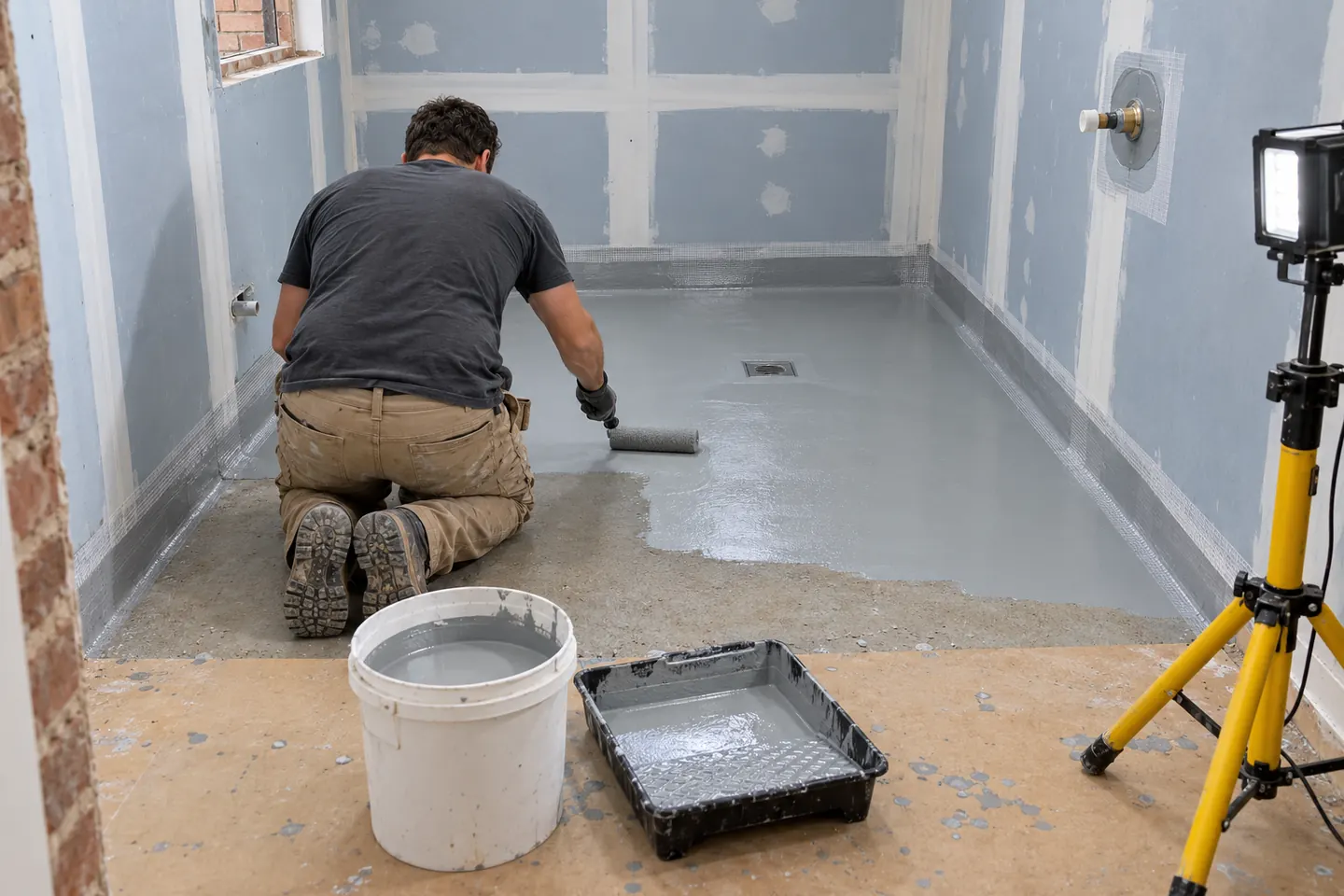
- Prime, then apply the membrane, detailing the junctions, penetrations and the wet-area extents properly rather than painting the field and hoping
- Let it cure for as long as the manufacturer says
- Tile, then grout, then silicone the movement joints
- Fit off and issue the certificate
Steps 5, 6 and 7 are where jobs fail, and they are invisible in the finished room. A floor that does not fall will pond. A membrane that misses the junction between the floor and the wall will leak at exactly the point water collects. A membrane tiled over wet will delaminate.
Floor falls, which are not optional
Water goes where the floor tells it to. In a shower the floor has to fall continuously to the waste, with no flat spots and no reverse fall at the perimeter, and in a step-free or wet-room layout the fall has to be managed across the whole room rather than inside a hob.
A linear waste against a wall makes this easier to achieve and easier to tile, because the floor only has to fall in one direction. A centre square waste needs four planes meeting at a point, which is perfectly doable but takes more care in the set-out.
Tiling: the set-out comes before the tile
The choice people spend most time on — which tile — matters less than where the first one goes. A set-out is worked out before anything is cut:
- Where the cuts land. No sliver cuts in the most visible corner, and no half-tile running down the wall you see from the doorway.
- How the wall tiles line up with the floor tiles, if they are meant to.
- Where the niche or shelf sits relative to the tile grid, so it reads as deliberate.
- How the tile meets the waste, the door threshold and the vanity.
- Movement joints at the internal corners and the floor-to-wall junction, in flexible sealant rather than grout, so normal building movement does not crack the grout line.
Choosing tiles for a house like this
Porcelain over ceramic on the floor. Harder, less porous, and it takes the traffic a full household puts through a bathroom.
Appropriate slip classification on the floor, especially in the shower. The slip ratings guide covers the R and P classifications, where each one is relevant, and the cleaning trade-off that comes with more texture.
Full-height walls in the shower, and preferably full height throughout. Painted plasterboard above a tile band is the surface that goes mouldy first in a room with poor ventilation.
Mid-size rather than oversize in a small room. A 300 by 600 tile laid well beats a 1,200 slab cut badly around a waste.
Grout colour one shade darker than you think. Brilliant white grout on a bathroom floor looks superb for eleven months.
What you should be given at the end
A waterproofing certificate, the tile and grout details in case a repair is needed later, and the fittings list from the quote. Keep all three with the house papers.
Next step
If the joints are simply stained or crumbling, the fix may be smaller again — how to regrout a shower walks through it and explains when grout is not the real problem.
If the problem is a leaking shower rather than a tired bathroom, say so when you ring — it is often a smaller job than people fear. If the whole room has reached the end, the full bathroom renovations page covers the complete rebuild, and the rough bands are on the price guide.
Renovation work is carried out in partnership with Coastal Renovation Group, a licensed NSW builder. Licence and insurance details are provided on request.