Before anything starts
1. The call. Suburb, which room, roughly how big, and when the house was built. That last one tells us whether an asbestos test is part of the job.
2. The measure. About half an hour at your place, free, and available in the evening or on a Saturday. The room is measured and drawn. We confirm the floor type, trace the drainage route, identify the wall and ceiling sheeting, check the hot water system if a second bathroom is in play, and look for the signs of a shower that has been leaking.
3. The written quote. A fixed price, itemised, with the fittings named and the tile allowance stated, and the mechanism for pricing anything found during strip-out written down rather than left vague. If asbestos testing is needed it is listed; if removal turns out to be required, it is a separate line once the result is in.
4. Selections. Tiles, tapware, vanity, toilet, screen, lighting. Getting these locked before the start date is the single biggest thing a customer can do to keep the job on schedule, because a job waiting on a tile delivery is a job standing still.
5. The booked start date, with the days the room will be out of action named.
On site
6. Protection and set-up. Floors and the access route covered, the skip positioned, power and water arrangements confirmed.
7. Asbestos testing and, if needed, removal. Testing before anything is cut. A positive result means a separately licensed asbestos removalist attends before the rest of the trades, with a clearance before work resumes. This is the stage that most often moves a start date, which is why it is settled before the booking rather than after.
8. Strip-out. One to two days. Tiles, bedding, screed, fixtures, screen and usually the ceiling lining. This is the loud, dusty day.
9. Repairs. Anything the strip-out uncovered: rotted framing, soft floor sheeting, a damaged slab edge, borer in a timber floor. Half a day to several days depending on what is there.
10. Rough-in. Plumber and electrician. New water and waste lines, the wiring for lighting and the exhaust fan, and the solid timber backing for anything that will later be screwed to a wall — grab rails, a shower seat, a wall-hung vanity. This is the only chance to put that backing in.
11. Sheet and screed. Wet-area wall sheeting fixed and set, and the floor screeded to a continuous fall toward the waste. The screed then has to go off before anything goes on top of it.
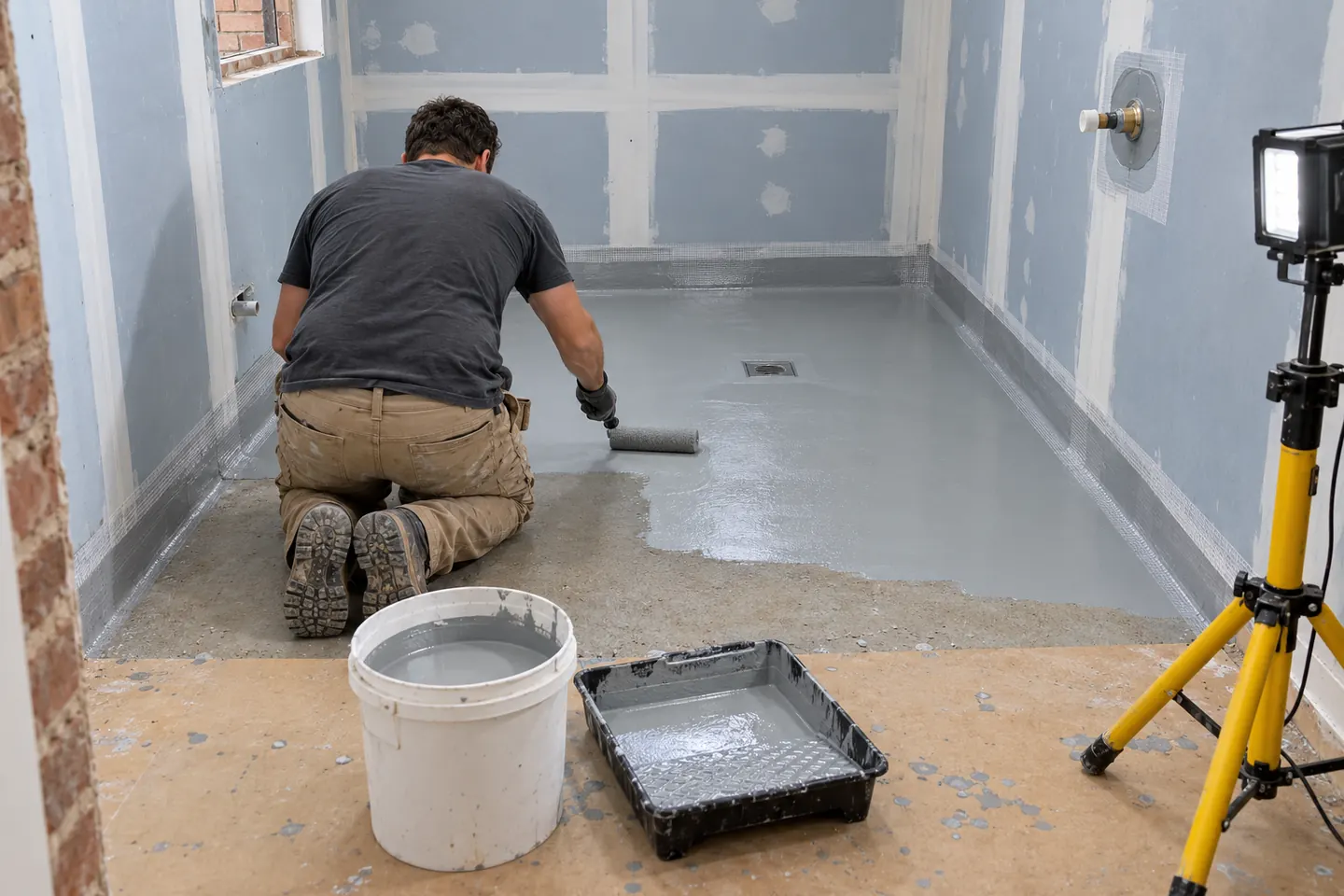
12. Waterproofing, then the cure. Primer, then the membrane, with the junctions, penetrations and wet-area extents detailed properly rather than painted over. Then it cures, for as long as the manufacturer's data sheet says — commonly a day or two, longer in cool or humid weather.
This is the stage people want compressed and it is the one stage that must not be. A membrane tiled over before it has cured will fail, and you will not find out for years. Nothing happens on the cure days. We tell you in advance which days they are.
13. Tiling and grouting. Three to five days for a full room, depending on the tile size and the amount of cutting. The set-out is worked out before the first cut, so the visible walls carry full tiles and the cuts land where nobody looks. Grout goes in, then flexible sealant in the movement joints at the internal corners and the floor-to-wall junction.
14. Fit-off, clean and hand-back. Tapware, toilet, vanity, screen, mirror, accessories, lighting and the exhaust fan. Final clean. You get a walk-through, the waterproofing certificate, and the fittings list from the quote.
A realistic calendar
| Stage | Typical working days |
|---|---|
| Strip-out | 1 – 2 |
| Repairs found during strip-out | 0 – 3 |
| Rough-in (plumbing and electrical) | 2 – 3 |
| Sheeting, setting and screed | 2 – 3 |
| Waterproofing and cure | 2 – 4 (mostly waiting) |
| Tiling and grouting | 3 – 5 |
| Fit-off and clean | 2 – 3 |
That totals roughly 12 to 23 working days, which is the three to four calendar weeks most full renovations take. Add the asbestos removal stage if a test comes back positive.
Living through it
- Decide where everyone showers before demolition day, not during it
- Clear the room completely, including the cabinet and the back of the door
- Keep children and pets out of the work area, particularly on strip-out day
- Expect dust beyond the bathroom despite the protection, especially on the first day and on any day a slab is cut
- Do not plan a family event in the middle of it
- Keep a box of essentials somewhere else in the house — towels, toothbrushes, medication
What you get at the end
The waterproofing certificate, the tile and grout details in case a repair is ever needed, and the fittings schedule. Keep all three with the house papers; the certificate in particular matters if you sell.
Rough price bands are on the price guide. If you would rather read answers than a sequence, the questions page covers the rest.
Call 02 4404 0504 for a free measure, seven days.
Renovation work is carried out in partnership with Coastal Renovation Group, a licensed NSW builder. Licence and insurance details are provided on request.
Keep going
Where people head next
Questions people ask before they commit
How many weeks from the first call to a finished bathroom?
Allow roughly two to four weeks from the measure to the start date, mostly for materials and scheduling, then about three to four weeks of site work for a full renovation. Smaller jobs are shorter. The site-work figure includes the waterproofing cure, which is waiting rather than working but cannot be skipped.
Will there be trades here every day?
No, and a job with somebody on site every single day is usually a job being done in the wrong order. There are days where the membrane is curing or the screed is going off and nothing can happen. We tell you which days those are so you are not sitting at home waiting for a knock.
What if it is our only bathroom?
Then the dates matter more than anything else on this page. Before demolition starts you get the specific days the room is unusable, so you can arrange showers at a relative's house, at work or at a local pool. We do not start a single-bathroom job without that conversation.
What happens if something is found during demolition?
We stop, photograph it, and tell you what it is and what it costs before anyone proceeds. The usual finds are rotted framing, soft floor sheeting or an old leak that has been running for years. The quote sets out how repairs like that are priced, so it is a known mechanism rather than a negotiation.
Can we live in the house during the work?
Almost always. The work is confined to one room, the rest of the house is protected and the route in and out is covered. Demolition day is dusty and loud, and the day the slab is cut, if it has to be cut, is louder.