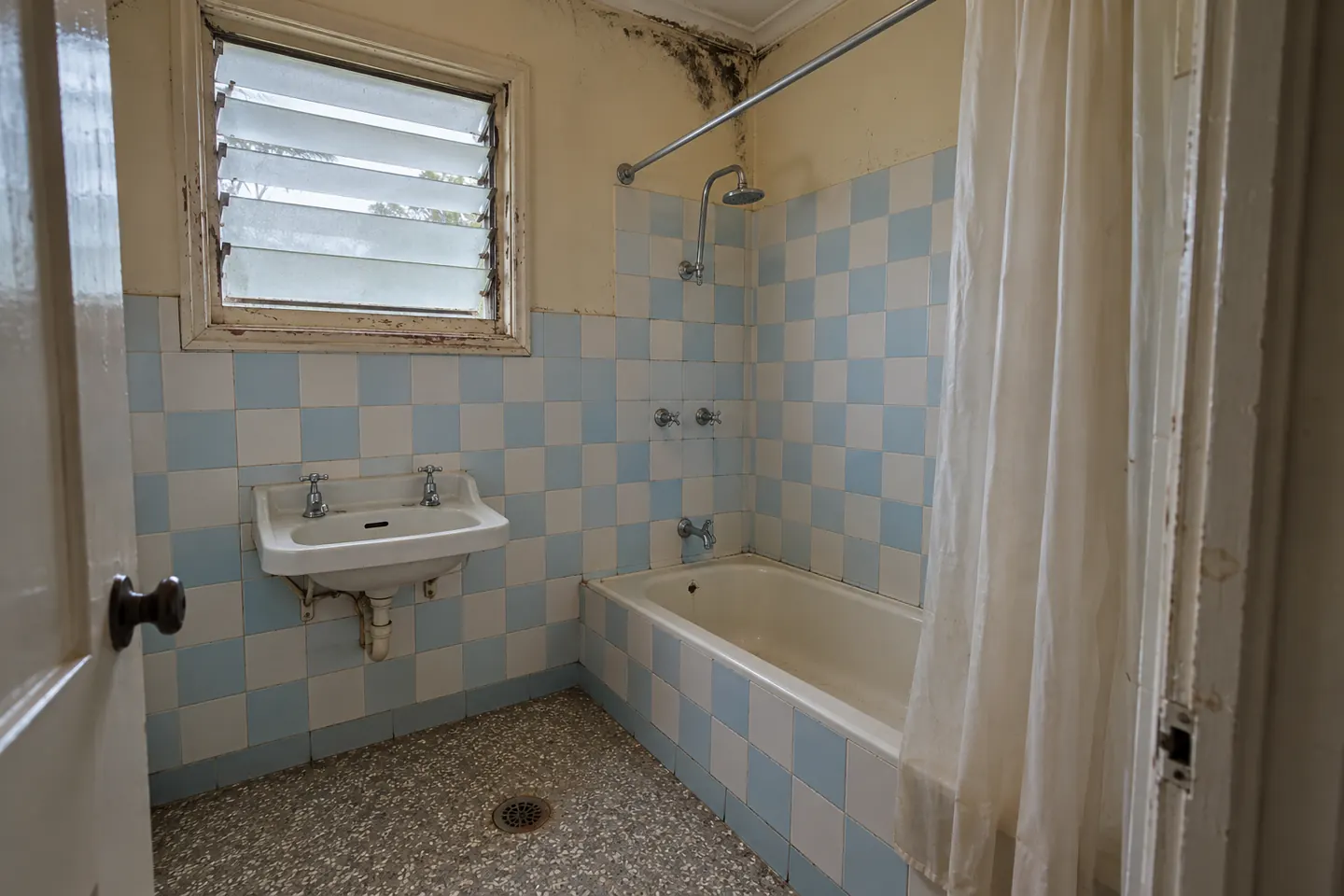
The honest answer: you cannot confirm asbestos by eye
People search this question hoping for a photo they can match against their bathroom wall. That photo does not exist, and anyone who tells you they can confirm asbestos by looking is guessing.
The reason is simple. Asbestos was mixed into ordinary building products — mostly cement sheet, vinyl flooring and adhesives — and the asbestos-free versions that replaced them look and feel almost exactly the same. A grey fibre-cement sheet made with asbestos and one made with cellulose fibres are, to the naked eye, the same sheet.
What you can learn is where asbestos is likely to be, what the warning signs are, and what to do before anyone picks up a drill. The only confirmation is a laboratory test of a sample, analysed by a NATA-accredited laboratory and ideally taken by a licensed asbestos assessor.
Where asbestos turns up in older bathrooms
Wet areas were one of the most common places builders used asbestos cement, because it resisted moisture far better than the plasterboard of the day. If your home was built or renovated before the mid-2000s and the bathroom has not been fully rebuilt since, these are the places worth thinking about.
Wall linings behind the tiles. The single most common location. Flat fibre-cement sheet was nailed to the studs and tiled directly over, especially around the shower and bath. You usually only see it when a tile cracks or falls off, or from the back if a wall is open.
Ceiling sheets. Flat sheets with cover strips at the joins, similar to external eaves lining, were often used in bathroom and laundry ceilings.
Vinyl floor tiles and sheet vinyl. Some older vinyl floor tiles — often small square tiles in muted colours — contained asbestos. So did the felt-like backing on some sheet vinyl, and some of the black or dark adhesives used to stick them down. Look under an old bathroom's floor covering before assuming it is plain timber or concrete.
Less common bathroom sources. Some older moulded toilet cisterns, the lagging on old flue pipes from gas water heaters, and the backing boards of wall heaters can contain asbestos. These are less typical in a bathroom but worth noting if your room has original fixtures.
Visual cues that justify a test
None of these proves anything. Together, they tell you whether a sample is worth taking.
- A hard, grey, cement-like sheet rather than paper-faced plasterboard. Plasterboard has a paper face and a chalky core that crumbles when broken; fibre-cement is dense, rigid and noticeably harder.
- A dimpled or pock-marked texture on the back of the sheet, sometimes described as looking like a golf ball. Visible where a sheet edge is exposed or from inside a wall cavity.
- Joining or cover strips — timber, metal or plastic battens covering the joins between flat sheets, especially on ceilings.
- A regular grid of nail heads rather than screws, with no taped and set joins.
- Fibrous broken edges. A broken edge that shows fine fibres can be a clue, but modern fibre cement can also look fibrous, so do not break a sheet to check.
- Age and history. An original bathroom in a mid-century house, or one renovated decades ago, is a stronger candidate than a room rebuilt recently.
A useful rule of thumb: if you would need to drill, cut, sand or break the material to find out what it is, stop. Treat it as asbestos until a test says otherwise.
What to do — and what not to do
Don't disturb it. No drilling, cutting, sanding, grinding, scraping, water blasting or breaking tiles off the wall. Don't dry sweep or use a household vacuum on any dust. Bonded asbestos sheet in good condition is generally considered low risk while it is left alone; the risk comes from releasing fibres.
Don't start a strip-out on a hunch. Pulling tiles off an old wall is exactly the activity that turns a stable material into a hazard, in your own home and for your neighbours.
Get it tested. A licensed asbestos assessor, or a qualified occupational hygienist, takes a small sample with the right precautions, seals the sampled spot and sends the sample to an accredited laboratory. Results typically come back within days. For a full renovation, ask for an asbestos survey covering every material the job will disturb — walls, ceiling, floor coverings and adhesives — not just one sample.
If it is positive, use a licensed removalist. Removal has to follow a proper process: the work area is sealed and kept wet, the material is removed as intact as possible, wrapped and disposed of at a facility licensed to accept it. After removal, a clearance inspection confirms the area is safe before the renovation carries on. There are also rules about how much a homeowner may remove themselves and how it must be done — check the current rules with SafeWork NSW rather than relying on general advice, including this page. Friable asbestos — the crumbly kind, such as old pipe lagging — must always be removed by a licensed removalist.
Build it into the program. Testing, removal and clearance happen before demolition and usually add days or weeks to a bathroom job. A good quote states the asbestos position up front rather than discovering it halfway through.
Where to check the rules
Asbestos rules change and differ between states, so go to the source:
- SafeWork NSW — removal, licensing and what homeowners can and cannot do
- asbestos.nsw.gov.au — the NSW Government's homeowner guide, including where asbestos is found in homes
- asbestossafety.gov.au — the national Asbestos and Silica Safety and Eradication Agency
- Your local council — disposal options and any local requirements
Renovating an older bathroom?
If testing confirms asbestos, it does not stop a renovation — it changes the order of work. The removalist goes first, clearance is confirmed, and the bathroom renovation runs as normal from there, with the new walls lined and waterproofed properly. Removal is priced separately from the build; our renovation cost guide explains the rough bands and what moves them.
If you're in the Bankstown area and planning to renovate an original bathroom, raise testing when you book your on-site quote so it is planned before demolition, not discovered during it. Call 02 4404 0504 or send the details through.
Keep going
Where people head next
Questions people ask before they commit
Can you tell if something is asbestos just by looking at it?
No. Asbestos-containing fibre-cement sheet and the asbestos-free fibre cement that replaced it look almost identical, and the same goes for many old vinyl tiles and adhesives. Visual clues tell you what is worth testing. Only laboratory analysis of a sample confirms whether asbestos is present.
Where is asbestos most likely to be in a bathroom?
Most commonly in flat fibre-cement sheet used as the wall lining behind tiles and around the shower, in ceiling sheets, and in some older vinyl floor tiles, sheet vinyl backings and the adhesives under them. Some older moulded toilet cisterns and old hot water flue lagging can also contain it.
Is asbestos behind my bathroom tiles dangerous if I leave it alone?
Bonded asbestos sheet in good condition that is not being disturbed is generally considered low risk. The danger comes from releasing fibres — drilling, cutting, sanding, breaking tiles off the wall or water blasting. If you are planning any work that disturbs it, get it tested first.
How do I get a bathroom tested for asbestos?
Engage a licensed asbestos assessor or a qualified hygienist to take samples safely and send them to a NATA-accredited laboratory. Results usually come back within days. A renovation quote should state how the job will deal with the result either way.
Can I remove asbestos from my bathroom myself?
The rules on what a homeowner may remove, how it must be handled and where it can be disposed of are strict, and friable asbestos must always be removed by a licensed removalist. Check the current rules with SafeWork NSW before touching anything. For a bathroom strip-out, a licensed removalist is the sensible choice.