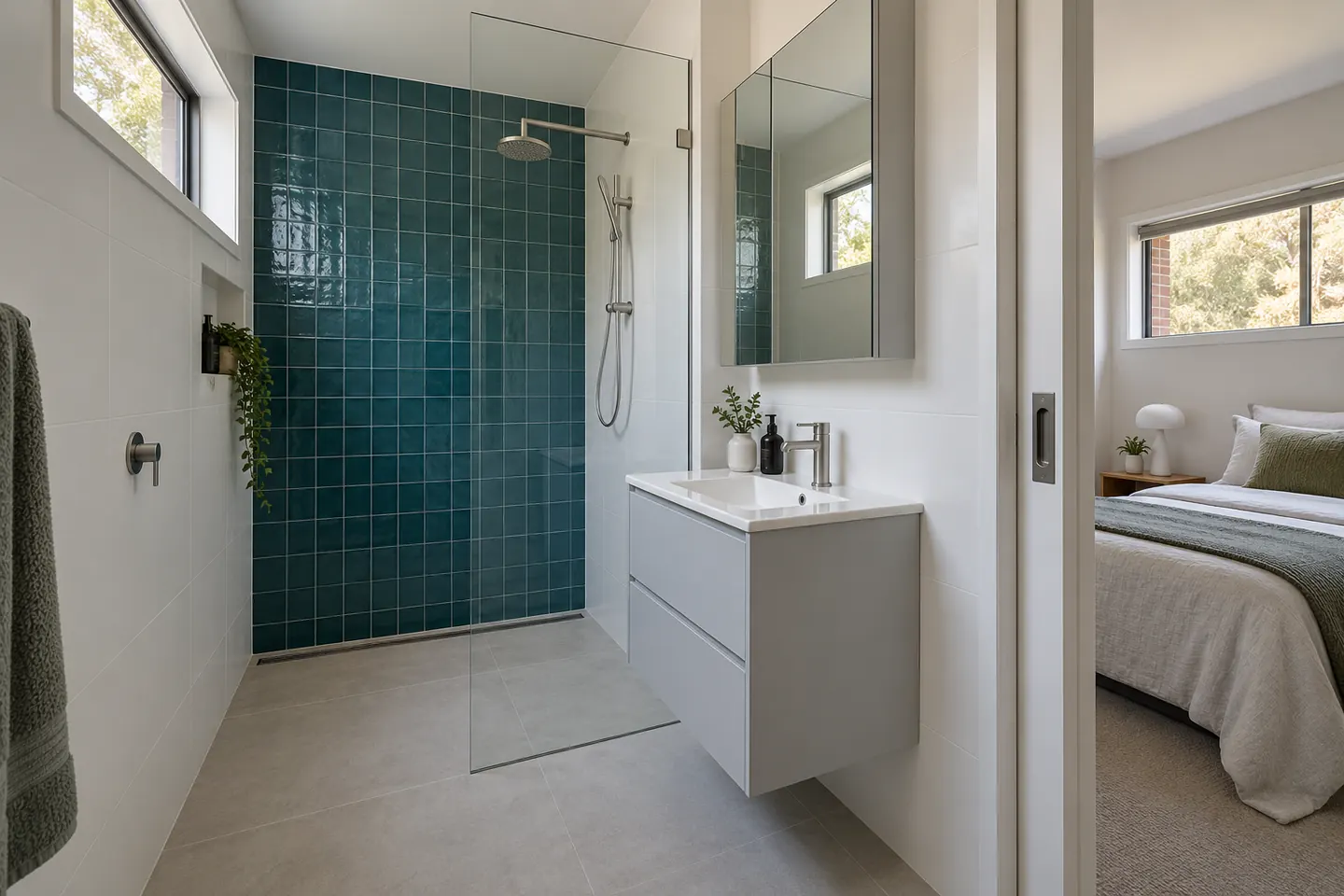
Two problems, not one
The first problem is electrical safety. Water and electricity in the same small room is the reason bathroom wiring is more tightly governed than wiring anywhere else in a house, and the governing idea is zones: imaginary volumes around the bath and the shower, within which a fitting has to meet a minimum standard of water protection and be suitable for the position.
The second problem is whether the room is actually pleasant to use. A single fitting in the middle of the ceiling is compliant and nearly useless: it puts your own shadow on the mirror and leaves the shower dim.
Both get decided at rough-in, before the walls are sheeted, because that is when the cables are run. Changing your mind after tiling means breaking tiles.
Everything below is a planning explanation, not a wiring instruction. Electrical work in Australia must be designed and carried out by a licensed electrician, and the current wiring rules, not this page, set what is required in your room.
The zones, in plain language
The wiring rules divide the space around a bath and a shower into zones, measured from the edge of the bath or the shower outlet. The closer to the water and the lower down, the stricter the requirement.
Described loosely, so you can picture it:
- Inside the bath or the shower enclosure itself is the most restrictive space. Fittings here must be rated for direct water contact and are often required to run at low voltage.
- Directly above the bath or shower, up to a defined height, is the next zone. Fittings need a meaningful level of water protection — in practice this is where you buy a sealed, properly rated downlight rather than a decorative one.
- The volume immediately around the bath or shower, extending out a defined distance horizontally, is less restrictive again but still a wet zone. Splash protection is the governing idea.
- The rest of the room, beyond those zones, is treated much like any other room, though a bathroom is humid everywhere and sealed fittings last longer wherever you put them.
The exact dimensions, heights and voltage requirements belong to the standard and to your electrician. The useful thing for a homeowner to take away is the shape of it: height and distance from the water determine what you can install, and a fitting that is fine over the vanity may not be permitted over the bath.
Reading an IP number
Light fittings carry a two-digit IP code, such as IP44 or IP65. The first digit is about solid objects and dust. The second is about water, and in a bathroom it is the one to look at:
| Second digit | Protection against |
|---|---|
| 3 | Spraying water |
| 4 | Splashing water from any direction |
| 5 | Water jets |
| 6 | Powerful water jets |
| 7 | Temporary immersion |
As a rough planning guide: fittings in the general room area are commonly specified at IP44 or better, fittings above a shower at IP65 or better, and anything that could be submerged needs IP67. Those are conventions, not a substitute for the requirement your electrician applies.
Two practical notes. First, a fitting's IP rating applies as installed — an IP65 downlight pushed into a hole with a gap around it is not IP65 any more. Second, the rating belongs to the whole fitting including the driver or transformer, and a driver sitting in a humid roof space is the part that usually fails first.
Layering: the part that makes the room good
Compliance gets you a safe room. Layers get you a room you like.
Ambient light is the general fill. Recessed fittings spread across the ceiling, or a single sealed surface fitting in a small room, placed so you are not standing in your own shadow at the basin. In a room with dark tiles, allow for more of it than you think — a dark surface absorbs most of the light that lands on it.
Task light at the mirror is the layer most bathrooms are missing and the one people notice immediately. Light from in front of the face, not from above and behind it. A pair of fittings either side of the mirror at roughly face height is the ideal; a well-made illuminated mirror or a light bar above the mirror is the practical version. A single downlight in the ceiling in front of the mirror is the worst of the options, because it lights the top of your head and shadows everything under your brow.
Shower light is worth its own fitting rather than relying on the ceiling spread. A correctly rated sealed fitting over the shower turns the darkest part of the room into the clearest.
Low-level and accent light is optional and genuinely useful. A strip under a wall-hung vanity, on a separate switch or a sensor, means a child or an older adult can find the room at 3am without the full ceiling load coming on.
A workable specification for a family bathroom
- Two or three sealed ceiling fittings for ambient light, positioned to avoid shadowing the basin
- One correctly rated fitting over the shower
- A dedicated light at the mirror, in front of the face
- Optional low-level light under the vanity on its own switch
- Around 3,000 to 4,000 kelvin throughout, and the same figure on every lamp in the room
- A colour rendering index of 90 or better where anyone shaves or applies make-up
- Dimming on the ambient circuit if you want it, specified at purchase rather than added later
- Switches positioned where the rules allow, and findable in the dark
Get it on the drawing early
The one thing worth repeating: this is a rough-in decision. The cables, the fitting positions and the switch positions are set before the wall sheeting goes on, and before the waterproofing and tiling that follow. Working out where you want light while the room is open costs nothing; working it out afterwards costs tiles.
That is why lighting is part of the conversation at the measure on a full bathroom renovation, not an afterthought at fit-off. For what the whole job costs, see the price guide.
Renovation work is carried out in partnership with Coastal Renovation Group, a licensed NSW builder. All electrical work is carried out by a licensed electrician. Licence and insurance details are provided on request.
Keep going
Where people head next
Questions people ask before they commit
What does IP actually stand for?
Ingress Protection. It is a two-digit code: the first digit rates protection against solid objects and dust, the second against water. For bathrooms it is the second digit that matters. IPX4 means protected against splashing from any direction, IPX5 against a water jet and IPX7 against temporary immersion.
Can I put a downlight directly over the shower?
Yes, with a fitting rated for that position. A light above a shower sits in a zone where the wiring rules require a minimum level of water protection and where the fitting must be suitable for the location. Your electrician determines the exact requirement for your room; your job is to buy a fitting that meets it rather than the prettiest one in the showroom.
Do I need an electrician for a light fitting swap in a bathroom?
Yes. Electrical work in Australia must be carried out by a licensed electrician, and a bathroom is one of the locations where the rules around positioning and ingress protection are strictest. Swapping a fitting in a wet area is not a DIY job.
Are LED strips a good idea in a bathroom?
They can be excellent for indirect light under a vanity or behind a mirror, provided the strip and its power supply are rated for the position and installed by an electrician. Keep the driver out of the wet zones, and choose a strip with a sensible colour rendering figure or skin tones will look wrong.
What colour temperature should bathroom lights be?
Somewhere around 3,000 to 4,000 kelvin suits most bathrooms: warm enough to be comfortable, neutral enough to shave, apply make-up and check whether something is clean. Below about 2,700 kelvin everything looks yellow; above about 5,000 it reads as clinical.